IRDAI's New Insurance Distribution Rules 2026, Explained


What Happened, and Why
On 23 September 2026, IRDAI released a consultation paper called "Recalibrating Economics of Insurance Distribution". It proposes changes to who can sell insurance in India, how much they can earn, and how they sell it. The market reacted fast: PB Fintech's shares closed 34% lower and Turtlemint's fell 20%, according to IANS.
IRDAI's reason is in its own numbers. Between FY23 and FY25, new business premium sourced by a sample of corporate agents rose 28%. What those agents were paid rose 125%, according to Angel One's summary of the paper. Distribution costs grew far faster than the business they brought in.
Two things are worth knowing before reading the table. First, most of it is still a proposal. Comments are open until 25 October 2026, and the final rules may change, as Business Standard notes. Second, one change is already law. Since July 2026, intermediary registrations no longer need renewing every three years. They stay valid as long as the annual fee and compliance requirements are met, per Business Standard.

What the Table Shows
The changes fall into four groups.
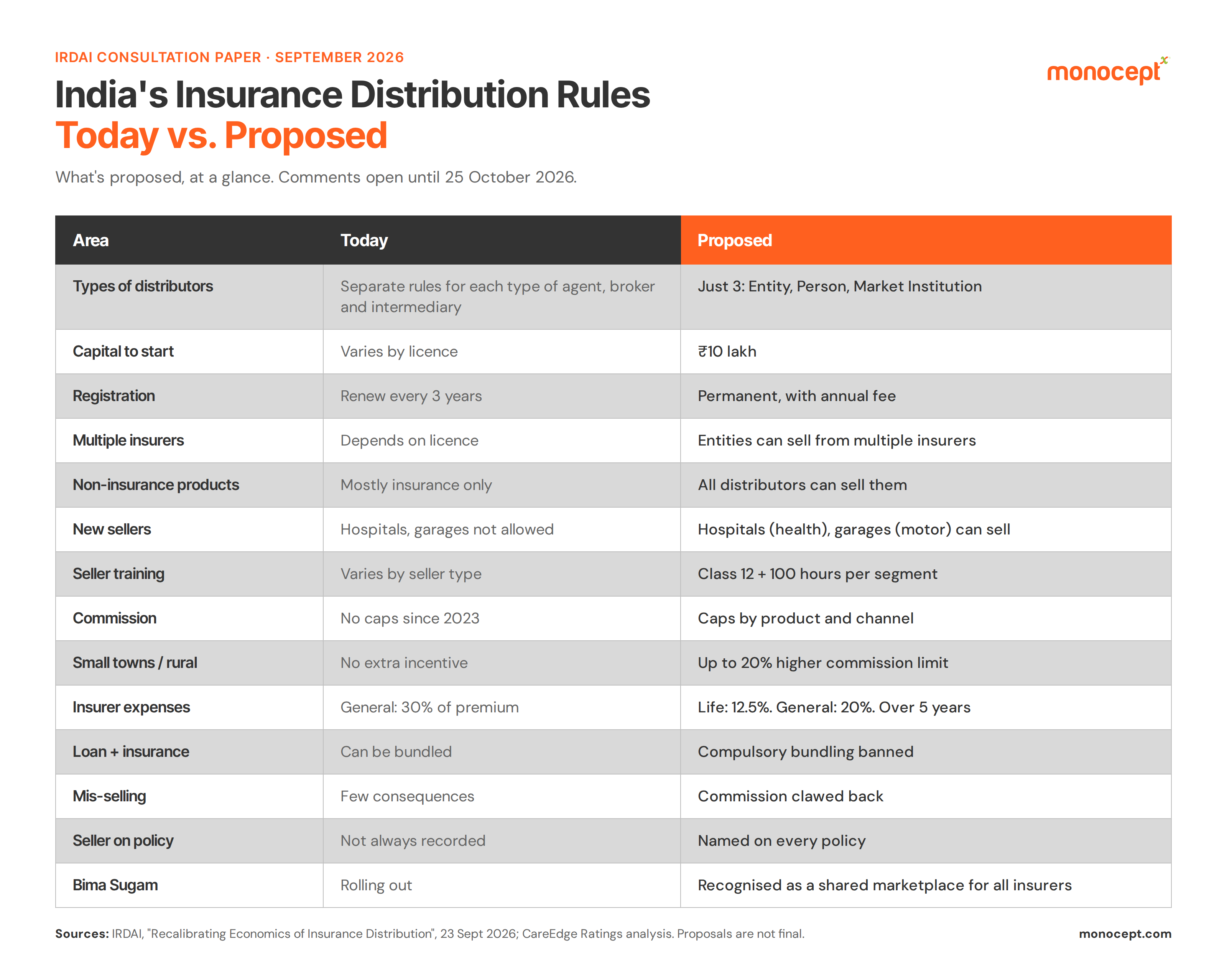
Who can sell
Today, each type of agent, broker and intermediary has its own set of rules. The paper would replace them with three categories: Insurance Distribution Entities, Insurance Distribution Persons, and Market Infrastructure Institutions. Entities would need ₹10 lakh to start and could sell products from multiple insurers, according to Inc42. Hospitals and garages could also distribute.
All distributors could also sell non-insurance products. Individual sellers, in turn, would need a Class 12 qualification and 100 hours of training per segment, according to CareEdge Ratings' analysis of the paper.
What they can earn
Commission caps were removed in 2023. The paper brings them back, set by product, channel and effort. For a life policy with a premium term of 10 years or more, the first-year cap would be 20% for entities and 25% for agents, per Upstox. To support underserved markets, business from rural areas and small towns would get up to 20% more headroom on the commission limit.
Insurers' overall expense limits would also tighten over five years. General insurers, currently allowed up to 30% of premium, would come down to 20%. Life insurers would come down to 12.5%, according to Business Today. That's a big ask for most of the market. Private general insurers already spend 32.1% of premium, above today's limit, and 20 of 22 life insurers and 28 of 31 general insurers are above the proposed 2029 ceiling, per CareEdge Ratings.
How they sell
Compulsory bundling of insurance with loans would be banned. A lender that wants a loan portfolio covered would need to buy a group policy and pay for it, per Outlook Business. Every policy would be tagged to its seller, and where mis-selling is confirmed, commission would be clawed back.
Where they sell
Bima Sugam would be recognised as a shared marketplace for all insurers, the first platform in the Market Infrastructure Institution category. It doesn't sell insurance itself. It's where customers, insurers and sellers meet to compare and buy.
What This Means for Insurers and Distributors
If the proposals go through largely as written, three practical needs follow.
Selling for more than one insurer. A distributor working with several insurers needs one place to manage their products, quotes and servicing, instead of a separate portal for each.
Tracking commission by product and channel. Caps that vary by product, channel and location, plus clawbacks for mis-selling, are hard to run on spreadsheets. Every payout needs to be calculated against the right cap and traceable afterwards.
Recording who sold what. From 1 January 2027, every policy must name the person who sold it. That has to be captured at the point of sale, not reconstructed later.
These are the problems Mozart Distribution Pro and Commission Pro are built for: configurable partner journeys across insurers, and automated commission calculation with maker-checker controls. If you want to work through how the proposals affect your distribution setup, get in touch.


.svg)
.png)