



.jpg)

Delayed Detection Leads to Higher Fraud Exposure
Where traditional claims handling falls short - and how the engine improves control and accuracy.

Fraud indicators surface after settlement decisions are already underway.
The engine flags fraud indicators before settlement decisions are initiated.

Manual review of large claim document volumes creates delays and missed signals.
Structured data is extracted automatically from claim documents using OCR.

Single-point checks miss cross-dimensional fraud patterns across claims.
Identity, clinical, financial, and network signals are correlated across every claim.
Core Capabilities that Power Intelligent, End-to-End Claims Risk Detection

Analyzes claim data, documents, policies, history, and behavioral signals throughout the lifecycle.

Extracts structured information from claim documents and validates it against policy details.

Surfaces potential fraud indicators before settlement decisions are initiated - not after.

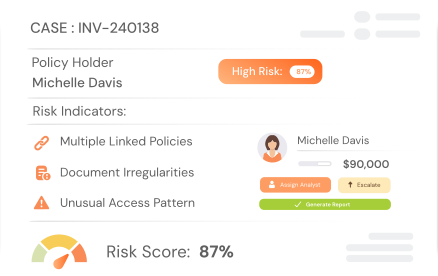
Correlates identity, clinical, financial, provider, network, and historical patterns across every claim.

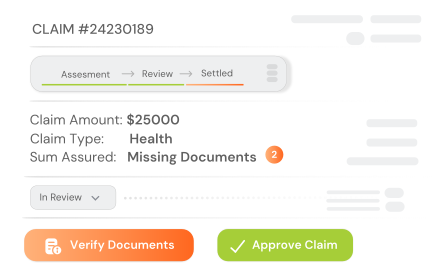
Assigns each claim a fraud risk score with confidence levels to direct investigator focus.

Every flagged anomaly includes clear reasoning and evidence — no black-box decisions.
Risk Detection that's Embedded in the Process
Risk assessment built into the claims lifecycle

Continuous signal analysis
Behavioral pattern detection
Risk embedded, not bolted on
Every flag comes with clear, actionable reasoning
Explainable fraud signals
Confidence-level scoring
No intuition-dependent review
Fraud patterns visible across multiple claim dimensions
Identity and clinical checks
Provider and network analysis
Historical pattern correlation
Insights on Modern Insurance


.svg)
.png)

Get answers to common questions
Find solutions to frequently asked questions regarding the AI-Enabled Claims Risk & Intelligence Engine
Fraud indicators are surfaced at the earliest stages of the claims lifecycle, well before settlement decisions are initiated.
Every flagged anomaly is accompanied by clear reasoning and evidence, so claims teams can act without relying on intuition alone.
It analyzes claim data, documents, policy details, historical claims, and behavioral signals, validating information against policy terms and external data sources.
Each claim is assigned a fraud risk score with confidence levels, allowing investigators to focus efforts where the probability and impact of fraud are highest.
It evaluates identity, clinical, financial, provider, network, and historical patterns - correlating signals across multiple dimensions to uncover anomalies not visible through single-point analysis.